Sunday, August 21, 2011

Holy Trinity Church (Goodramgate), York

I had every intention of writing last week, but lost 10 pounds in two days on the lower intestinal flu diet.  Needless to say, I was a bit incapacitated.  (Unfortunately the weight came back after I was able to drink enough fluid.)

Back to York...

There are a great many churches within Medieval York, which surprised me at first.  I didn't think there were enough people that lived there at the time to support that many, but then Janilee reminded me that it was a county seat and a major international trade center.  There may not have been that large (comparatively) of a permanent population, but the numbers coming in and out of the city made up the difference.

The Holy Trinity Church (Goodramgate) is kinda hard to find.  The entrance is a small iron gate with a triangular clapboard sign that is put out during business hours.  The yard and church are behind tall walls that don't look any different than all the other back sides of other buildings in the area.  I think we passed it three times before I noticed the sign board.  Oh, and you have to specify the Goodramgate part to differentiate it from the other Holy Trinity churches in town.

When you get through the gate you see this:
To the left of the tower and just above the tree you see the spires of the Yorkminster, just to give you an idea of how close it is to other churches.  Also you can see the walls on the left.  A gardener was pulling ivy off the walls when we got there, and chatted with us briefly.  Mostly he complained about the ivy, but invited us to enjoy ourselves, and that they closed in an hour and a half.

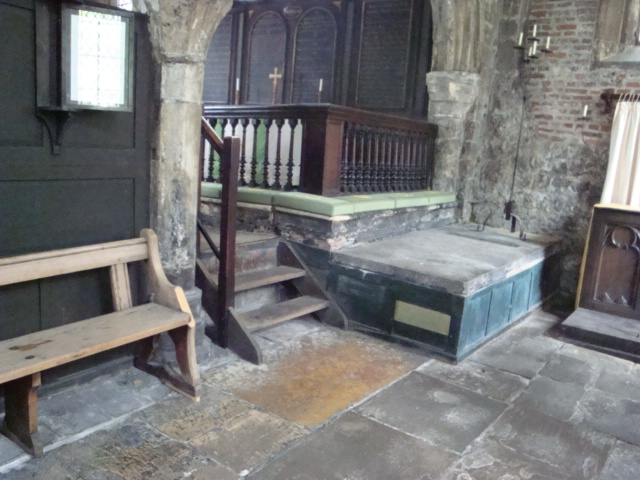
 The church was built in the 1100's, but was fitted with box pews in the 15th century.  It is one of the few places in England that still has the original pews.  Apparently they were put in for families to sit at while listening to the long sermons of Protestant ministers.  Lunch would be brought, and depending on the exact congregation, activities for the children may also have been included.
So many people were buried in this church that the main floor is now a couple of feet higher than the original floor.  This shot was taken from a side apse.
The church is also known for its medieval stained glass windows that somehow survived World War II fairly intact, though some small repairs had to be done.  I got such a kick out of this repair, I had to take a close up of it for my husband.  Plus it's cute.

The windows (obviously):
  The repair:
I don't know why they decided little yellow cartoon airplanes, but there you are.

My computer is being weird - either that or my internet connection is - so I'm going to close this entry.  Next week, I'll post some other random York pictures, and try to tell you a bit about my actual work.  Most days I don't really go rambling over the local countryside, but sit and read and think about the PhD stuff.  My husband reminded me today that was
original intention of the blog, so I probably ought to mention it from time to time.

Sunday, August 7, 2011

More York

It's kind of odd.  I spend all week thinking about what to post, planning to do it on a Sunday evening, when I take a break from schoolwork.  But then Sunday comes along, and I have a hard time finding things to write down.  Not what to write about, just what to say about it.  Weird.

Anyhoo, more about York. 

Within the walls of the city there are very few cars, and most of the streets are not accessible to them during day hours by law.  It is understandable, really, as most of the streets were built up during the late Medieval era, and there is usually only room for one vehicle to pass, without room for pedestrians.  Even with these toy cars you can park by picking it up with one hand that seem to be popular here.  But that's a rant for another day.

The buildings are a really interesting mix of modern and medieval right next to each other, and sometimes in the same building.
Here's a close up of a couple of the faces, just because.


This wonderfully well preserved and cared for Tudor building (is that right?  I need to bone up on my architectural styles) with fun painted faces and delightful stained glass is also, as you can see, a TK Maxx clothing store touting the latest styles.

I passed a realtors' on one of my trips being lost within the city and found an ad in the window for a building like this, only not so ornate.  You can own your very own Tudor building in the walled city of York for a mere 795,000 pounds sterling.  And, according to some men we spoke to in a pub where we had lunch, one of which was the owner of the establishment, you have to have Council Planning permission to paint, change the floors, or drive a nail.  And should you want to update to modern conveniences like electricity, you have to move a mountain of paperwork. (Actually, all the buildings have electricity, I'm sure, but you can't change anything about the historic aspect of the place when you renovate.)

One of the more interesting sections to get lost in - trust me, you will get lost - is The Shambles.  Starting out as a poor section of town that housed butchers and the like, the streets are small and winding, with straight lines apparently a concept that hadn't occurred to the early city planners...if they existed.
See what I mean about the cars?

Evidence of the butcher's shops are in street names...
(There is a spider's web around the piglets, which gives me the giggles for some reason)

...and the ancient butcher's hooks that can still be seen on or under the eaves of some of the shops.
I like this building.
And the detail on this one, that started out as a booksellers.
The historic information plaque for it is helpful.
And who wouldn't like a Tudor building that is so old it sags, next to a pub called the Golden Fleece with a large gold sheep hanging as the sign?  Or maybe that's just me.
Here's a close up of the sheepie:
There is also a Roman Bath museum that we didn't get to that is housed inside a pub (where else...This is Britain, after all), and all kinds of strange little shops.  But ten pictures is probably enough for one blog entry.


Next week, churches!

Sunday, July 24, 2011

York

A week or two ago, I went to York to meet with Penelope Walton Rogers who is a major name in my field of study, and also happens to be one of my thesis advisors.  We were to meet on a Wednesday, but I couldn't take a train there and not spend a day playing tourist.  I brought my friend Janilee Plummer, also an American PhD working under Gale, who did her archaeological dig work in York as a guide.  We took a room in The Dairy Guest House, just south of the walled medieval part of the city, and spent Tuesday and Thursday looking around the city and meeting with her friends.
A picture of the walls, of course.  It constantly astounds me how close modern living is in relation to all these medieval landmarks I've seen only in pictures while I was in the States.  I think, because there is so much space in America, and we tend to protect our national monuments by buying up the surrounding land to put a buffer around them, that I expect the same here on this small island.  The image I put up shows one of the major roads in York and its proximity to the old walls.  You can walk on the walls by going up through one of the gate towers.
I didn't go up...this time.  I really am going to have to go back.  Lots.  I need to see the Minster, go on a Ghost Walk, check out the Roman Bath museum.  They also have Craft Walks that include shops like Duttons for Buttons (I found the craft walk pamphlet on Thursday and showed it to Janilee, then got roundly cursed for not finding it sooner).  And this shop, which I passed coming from Penelope's work:
Of course I had to get a picture.

I saw the Jorvik Viking Center first thing.  They don't allow pictures on the tour, but I did get some of the combs they had on display.  I also talked for a bit to some of the people that worked there who were in garb, including one gal who was doing some naalbinding.  We got around to the topic of my thesis (I was about to say dissertation, but that's American) and she started asking questions, which led to brainstorming with others that worked there, and eventually I got a list of six books to investigate.   So, do I count my time there as research or tourism?  It's a puzzlement.
This guy was in the window of the gift shop there at Jorvik.  Obviously, he his modeled after a Viking longboat prow.  He was donated by the artist, Pete Bowsher, the UK International Chainsaw Carving champion, from wood cut away from electric wires.  W-O-W.

When I was done with that, I waited for Janilee in a small brick courtyard in a bit of a drizzle (big surprise).  Under the branches of a large tree, a guy was talking about owls, and had brought along some specimens to demonstrate.  You could also get your picture taken with one or more of the owls.  Here's Gizmo.
This one is a 14 week old snowy owl, who was doing very well for being in public at such a young age.  She did get a bit miffed with her handler, as he demonstrated the noise they use for training, which is usually followed by her favorite treat, a chicken foot.  He didn't have one, so she demonstrated her feelings by turning her back to him and stretching her wings.
The picture isn't great because she didn't hold still very much.

This one is Buzz, as in Buzz Lightyear.
And this owl is the largest predatory bird known.  The handler was telling a story about that type of owl (I'm sure I'll be hearing from my husband shortly as to what exactly it is) was captured on film by a BBC documentary team working on a piece about wolves.  They were filming a pack of six wolves, when suddenly an owl of this type flew into the shot.  It was only on tape for about 32 seconds, but in that time this single bird killed three of the wolves and carried off a fourth.  Apparently, there is a copy of this on You Tube, but I haven't found it yet.  Anyway, here's the owl.
That was all within the first two hours of arriving!  I'm going to have to continue this next week, I think.  I'm really trying to update every Sunday...at least that's the goal.

Sunday, July 17, 2011

Flowers...as promised

I am constantly surprised at all the different flowering plants around here.  In Oklahoma, flowers stay around outdoors for such a short period of time, but here I saw the first flower, a snowdrop, in Platt Field Park on January 28.  Since then, something has always been in flower.

I love that, actually.  The walk along Denison to the bus stop is always fragrant, and Manchester as a whole doesn't smell like a big city, until you get to the very down town part of the city.  Even there, flowering trees are fairly common.

At the moment, butterfly bushes are blooming.  They grow here like weeds.  Seriously.  I've seen butterfly bushes on the tops of buildings, in abandoned lots, growing out of broken windows in derelict buildings...  They smell wonderful!  I do wish that they had nicer greenery, but the blossoms are amazing.

Anyway, here are some of the pictures I've been taking of the plant life I see around here.


Not a terribly exciting blog entry, but I've really been enjoying the plants since I got here.  They keep my walks and bus rides interesting.

Tuesday, June 21, 2011

Beverly Minster

This beautiful building is found in (you guessed it) Beverly in Yorkshire, and was the concluding building for our visit. 
It has such amazing stone work, with such detail, care and precision, its astounding.  We don't know the name of the artists who did the work, which is unfortunate.  They deserve recognition for what they did.
Just look at this sculpture of Saint Catharine (I know it's supposed to be her because she is always depicted with a sword and a wheel of fortune - not the tv show, but the wheel we all ride as our fortunes go up and down).  I'm very impressed by the drapery of the cloth, and how well it has withstood the effects of time.  The little grotesque at her feet is not quite so lucky.

One of the things that continues to surprise me, though I suppose it shouldn't by now, is the number of strange images that are obviously not religious that show up in these churches.  Like this guy who has a face instead of feet. Or maybe he is kneeling on a demon.
This creature is probably performing a rude gesture:


One of the strangest things to me was that within a working church with an assigned chaplain and specified meeting times there is a gift shop.  Stranger still was what I found in the gift shop.
Smack in the center there is a sarcophagus.  And commemorative floor and wall tiles paid for by wealthy families to memorialize their dead.  I'm not sure I ever figured out who was buried here, but the fabric details in the carving caught my attention.
There is such wonderful attention to what was probably a very costly and beautiful costume.  I would like to have seen it fully painted.


Over in the corner of the shop was the sarcophagus of this poor fellow:
The legs that give you a perspective of the size of this monument (which also indicates its comparative lack of importance) are those of my friend Hannah.  She was teasing me that I could not sneak up on her; she could hear me coming from the sound of my camera.  Well, I did eventually run out of battery.  But not before I got pictures of this lovely lacy stonework:
These beautiful pipes for the organ:
Or this interesting modern sculpture of pilgrims,
with their matching stained glass window.  (There's stained glass in the pilgrims themselves as well.)
I did not get pictures of the 68 misericords, the Norman era baptismal font or the grounds.

After visiting the Minster, Hannah and I stopped at a tea shop, where I picked up some traditional turkish delight, in the traditional flavors of rose and lemon.  I really enjoyed the rose flavored ones.  After the jello-like substance was gone, the scent of roses stayed in the roof of my mouth for about fifteen minutes afterward.  It was lovely.


Next time...flowers!

Sunday, May 22, 2011

St. Peter's at Barton-on-Humber

Next on that tour we crossed the Humber River over a suspension bridge.  I thought it was amusing that the retirement age people on the bus were excited about that.  But then, if you don't take a childish delight in things, where is the fun in life?

St. Peter's is an honest-to-goodness Anglo-Saxon church, with sections of the tower built around 970 AD.  It was decommissioned as a church around 1970 due to lack of attendance.  On the day that we were there, it was raining (big surprise), and so the walk up to the building was damp, grey, and had the type of atmosphere you would expect for walking through an ancient graveyard.
Unfortunately for this picture, my camera automatically adjusts to dim light.  Which is great if you are photographing medieval documents without a flash, but it did lose the quality of light that existed at this place on this day.

One of the gravestones reminded me of Snow White, because of its shape, and the Poe-like romantic quality of the ivy.
As you come around the corner from this, the tower comes into view.
The bottom level has the rounded arches supporting the pointed arches.  The second section, which was built about ten years later, has the pointed windows.  The top section was built sometime in the next century.  Here's a better view:
The rest of the building dates to the 14th century.  I like the wooden door within the door seen here:
The skeleton to the right just added to the feel of the place.

A view of the oldest part of the church from inside:
And then there is this very strange door.  It does not match the rest of the already eclectic building.  The rock work is very uneven, with stones poking out at various lengths, giving a somewhat eerie feel to it - like it was bricked up by someone in a hurry.  From the outside, however, the rock has been smoothed out. 
Because it is no longer a functioning church, and is owned by English Heritage, an archaeological dig was performed on the graveyard and under the flooring.  The interior of the building is now a strangely cheerful, macabre museum set up of what they found.
There are signs and exhibits discussing burial practices and how they had changed over the centuries.  One one interactive section you could push a button, answering the question of whether you would preferred burial or cremation (cheerful topic for a day out with the kids!)  Whole skeletons were on display, as well as old coffins, bones showing particularly nasty diseases, and this gem.
This poor soul was found with his skull cut open, as is visible on the picture, but also with a wooden stake replacing the vertebrae in his neck.  Hannah, a PhD that studies vampire and werewolf literature couldn't get her hands on pencil and paper fast enough.

The building was very interesting, and the grounds were beautiful, but I honestly can't decide which was creepier - the fact that there were bodies all over (well, under really) the place, or the fact that there should have been, but they had all been dug up.  It was astounding, either direction.

Of course, leave it to English Heritage to take all the fun out of things...
In case you can't read the finer print, it says "Please take care as historic sites can be hazardous."