Just a quick note, because I really should be working on my thesis chapter on Living History groups as a resource for experimental archaeology.
I have another blog called warpweightedweaversquestionnaire, for obvious reasons. (Its a questionnaire for any warp weighted weavers I can finagle into filling it out - research, you understand.) I just checked the statistics for it, and it was very encouraging. The site has had over 1000 hits, which is quite good for what it is. It's the number of countries that people come from that look at the site which is fascinating. Here's the list, so far:
US
UK
Australia
Sweden
Portugal
Russia
Germany
Spain
India
Brazil
Pakistan
Israel
Finland
Ireland
New Zealand
Canada
Phillipines
Netherlands
France
Norway
Malasia
Japan
Italy
I find this very encouraging!
Monday, October 15, 2012

Saturday, March 24, 2012
Problems with looms in museums
Apparently, in spite of good intentions, blogging will occur only once every three months. I'm really going to have to work on that.
I recently had to research and write a 5,000 word essay on a topic for my thesis that I had not really looked at: the historiography (what has been said in the past and why they thought that) of the warp weighted loom. It was really interesting, but also a lot of pressure, because it was a backup plan to getting my PhD. My panel didn't go very well, but they gave me another six weeks to do the new essay to see if I could be up to snuff. I rather suspect the problem there is the differences in expectations between the American and the British systems. We haven't been communicating well on the topic, because they didn't think to tell me (it's the way it has always been done) and I didn't know to ask (here are my expectations, does that match with yours). Anyway, the essay is written and in, but we are still waiting for one of the advisers to weigh in with her opinion.
So...as part of the research, I was reading through Marta Hoffmann's book on the warp weighted loom, which is currently the only text that is more than a couple of pages long. In one of her chapters, she was writing about the looms found in Norwegian museums, and discovered that most of them were sold by a man named Eilert Sundt, an antiquities dealer. He would go to the farmhouses around the areas where the looms had been used by somebody's grandmother, buy them and then sell them to museums as antiques. Most of the looms at the time were around a hundred years old, and nobody knew how to use them. Also they had been taken apart and piled in the attic or barn for storage, so the set up was unknown though the reconstruction of the loom itself is not difficult. None of them had a warp on them either, so neither the warping style of the looms nor the fabrics they had been used for were known.
Sundt came up with a solution to make the looms more salable. Hoffmann reports that he had a local floor loom weaver weave up a foot or so of a textile that seemed likely, then moved it from a floor loom to the warp weighted loom. This creates the problem of not only are the pieces not traditional or possibly even typical fabrics, the set up everyone is looking to for warping the looms is back engineered from floor loom techniques.
Personally, I don't really have a problem with this. You have to start somewhere. But it bothers me that modern weavers are not aware of this little difficulty. Also, my prickly adviser got on my case for suggesting the single line of loom weights solution is a back engineered solution from a floor loom weaver's perspective. That's fair enough. But so are the other solutions, so where is mine wrong where others weren't? I'm not trying to suggest that mine is the only way to do things. I figure weaving is like any other craft. People will find ways to do the work dependent on culture, desired outcome, physiology, and experimentation.
Anyway, its something to think about.
I recently had to research and write a 5,000 word essay on a topic for my thesis that I had not really looked at: the historiography (what has been said in the past and why they thought that) of the warp weighted loom. It was really interesting, but also a lot of pressure, because it was a backup plan to getting my PhD. My panel didn't go very well, but they gave me another six weeks to do the new essay to see if I could be up to snuff. I rather suspect the problem there is the differences in expectations between the American and the British systems. We haven't been communicating well on the topic, because they didn't think to tell me (it's the way it has always been done) and I didn't know to ask (here are my expectations, does that match with yours). Anyway, the essay is written and in, but we are still waiting for one of the advisers to weigh in with her opinion.
So...as part of the research, I was reading through Marta Hoffmann's book on the warp weighted loom, which is currently the only text that is more than a couple of pages long. In one of her chapters, she was writing about the looms found in Norwegian museums, and discovered that most of them were sold by a man named Eilert Sundt, an antiquities dealer. He would go to the farmhouses around the areas where the looms had been used by somebody's grandmother, buy them and then sell them to museums as antiques. Most of the looms at the time were around a hundred years old, and nobody knew how to use them. Also they had been taken apart and piled in the attic or barn for storage, so the set up was unknown though the reconstruction of the loom itself is not difficult. None of them had a warp on them either, so neither the warping style of the looms nor the fabrics they had been used for were known.
Sundt came up with a solution to make the looms more salable. Hoffmann reports that he had a local floor loom weaver weave up a foot or so of a textile that seemed likely, then moved it from a floor loom to the warp weighted loom. This creates the problem of not only are the pieces not traditional or possibly even typical fabrics, the set up everyone is looking to for warping the looms is back engineered from floor loom techniques.
Personally, I don't really have a problem with this. You have to start somewhere. But it bothers me that modern weavers are not aware of this little difficulty. Also, my prickly adviser got on my case for suggesting the single line of loom weights solution is a back engineered solution from a floor loom weaver's perspective. That's fair enough. But so are the other solutions, so where is mine wrong where others weren't? I'm not trying to suggest that mine is the only way to do things. I figure weaving is like any other craft. People will find ways to do the work dependent on culture, desired outcome, physiology, and experimentation.
Anyway, its something to think about.
Tuesday, January 24, 2012
'Chapter' for my thesis
I finished a piece of writing for my thesis that was sent to my advisers at 6:00 this morning. Most of it was composed after midnight, which says something about my skills as a writer - I'm just not sure what.
Oddly, they were expecting a piece on pin beaters, even though I'd only looked at a few from two archaeological sites. I'm fairly certain that is not enough information to make any sort of definitive statement about them. I chose to write on my preliminary findings from a questionnaire I devised for other people that work on the warp weighted loom instead, as that is a topic I have been thinking about for 10 or so years, so have a bit more to say even though there are only twenty one returned surveys at this point. (All right, 25, but some of those have yet to be read.)
Now I just have to wait until Monday for my panel to see if I will get an MPhil and be sent home, or can continue with the research for another two years. This week is gonna be a lot of fun, I can tell already.
Oddly, they were expecting a piece on pin beaters, even though I'd only looked at a few from two archaeological sites. I'm fairly certain that is not enough information to make any sort of definitive statement about them. I chose to write on my preliminary findings from a questionnaire I devised for other people that work on the warp weighted loom instead, as that is a topic I have been thinking about for 10 or so years, so have a bit more to say even though there are only twenty one returned surveys at this point. (All right, 25, but some of those have yet to be read.)
Now I just have to wait until Monday for my panel to see if I will get an MPhil and be sent home, or can continue with the research for another two years. This week is gonna be a lot of fun, I can tell already.
Sunday, November 20, 2011
apparently there are no such things as pin beaters...
Go figure. I did go to the archives of the Museum of London. There I saw ten 'thread pickers' or 'pin beaters'. Eight were double ended, which is usually associated with the warp weighted loom, and two were single ended, which has been cited as evidence for a two beamed loom, a tool which I am not yet convinced was used...but that is another entry.
The Museum of London also had a microscope I could use, which was really handy for looking at detail that was hinted at from visual examination.
The double ended pin beaters all had a rounded, flattened end, kind of like the butt end of a pair of tweezers, and under the microscope that end looked sharpened like a razor blade. But the sharpened section only covered about 1/4 inch along the very tip, which makes no sense for shoving between sections of warp threads to push weft threads up and between. That sort of tool use would be further up the shaft of the 'pin beater', I would think.
The two single ended pin beaters were even shorter and flatter than the ones I saw at York. And the tips were curved in a counter clockwise direction from the shaft of the beater. I have no idea what that would be for.
I also examined a roughout (a tool that was tossed aside before it was finished, for what ever reason) and discovered that the tool used for bone carving left skip marks along the length of the pin beater. These were not completely eliminated in the polishing process on other pin beaters that I examined. However, it would be possible to distinguish these skip marks from wear from rubbing against thread because the thread would leave wear marks around half to three quarters of the tool, and the skip marks only go for about a quarter of an inch or so. I'm not sure if that makes sense, but I can't really post pictures from the finds without permission of the museums. I intend to run tests on my ww loom, with the warp thread covered in chalk like that found in plumb lines, to show where the wear marks would be. It seems the fastest way to demonstrate proof of concept, as I don't have the time to weave a big enough piece to create the wear marks.
Next Thursday, I'm meeting with PWR and a gentleman named Steven Ashbury to discuss this. He is apparently interested in combs. I'm not really looking forward to this meeting, because PWR identified some of the single ended pin beaters, and this would negate her work.
I also went to a re-enactor's market and found a bone carver. These people sold me a composite comb, and I found a single ended pin beater - which when I said 'I want that' the bone carver said, 'The Roman stylus?', which kind of confirms my thoughts on that subject.
I brought the comb home, and tried my wooden weaving sword, the bone comb, and a replica wooden comb I picked up in Leeds, and tried them out as weft beaters. I discovered that I like the bone comb best for a beater. The wooden sword has to shove through the stickiness of hand spun wool, where the comb slides right through it. And the bone is better than the wood because it has more weight and is slicker. It does make me wish I had picked up a bigger wooden comb with nice heft to it that I saw at the re-enactor's market. I would like to have tried that comb out as well.
The Museum of London also had a microscope I could use, which was really handy for looking at detail that was hinted at from visual examination.
The double ended pin beaters all had a rounded, flattened end, kind of like the butt end of a pair of tweezers, and under the microscope that end looked sharpened like a razor blade. But the sharpened section only covered about 1/4 inch along the very tip, which makes no sense for shoving between sections of warp threads to push weft threads up and between. That sort of tool use would be further up the shaft of the 'pin beater', I would think.
The two single ended pin beaters were even shorter and flatter than the ones I saw at York. And the tips were curved in a counter clockwise direction from the shaft of the beater. I have no idea what that would be for.
I also examined a roughout (a tool that was tossed aside before it was finished, for what ever reason) and discovered that the tool used for bone carving left skip marks along the length of the pin beater. These were not completely eliminated in the polishing process on other pin beaters that I examined. However, it would be possible to distinguish these skip marks from wear from rubbing against thread because the thread would leave wear marks around half to three quarters of the tool, and the skip marks only go for about a quarter of an inch or so. I'm not sure if that makes sense, but I can't really post pictures from the finds without permission of the museums. I intend to run tests on my ww loom, with the warp thread covered in chalk like that found in plumb lines, to show where the wear marks would be. It seems the fastest way to demonstrate proof of concept, as I don't have the time to weave a big enough piece to create the wear marks.
Next Thursday, I'm meeting with PWR and a gentleman named Steven Ashbury to discuss this. He is apparently interested in combs. I'm not really looking forward to this meeting, because PWR identified some of the single ended pin beaters, and this would negate her work.
I also went to a re-enactor's market and found a bone carver. These people sold me a composite comb, and I found a single ended pin beater - which when I said 'I want that' the bone carver said, 'The Roman stylus?', which kind of confirms my thoughts on that subject.
I brought the comb home, and tried my wooden weaving sword, the bone comb, and a replica wooden comb I picked up in Leeds, and tried them out as weft beaters. I discovered that I like the bone comb best for a beater. The wooden sword has to shove through the stickiness of hand spun wool, where the comb slides right through it. And the bone is better than the wood because it has more weight and is slicker. It does make me wish I had picked up a bigger wooden comb with nice heft to it that I saw at the re-enactor's market. I would like to have tried that comb out as well.
Sunday, November 6, 2011
When is a pin beater not a pin beater...
I've been planning to update the blog every Sunday for a while now, but obviously hadn't gotten around to it. I didn't realize it had been so long, until I checked it last Sunday, just before choir practice. I need to be a whole lot more consistent than I have been.
Update time:
I love my classes (no surprise - I love to teach!) even though they are late on a Friday morning. I have a grand total of 15 students: five in one class and 10 in the other. They are back to back, and in different buildings, so it's a challenge getting between them. They are willing to participate, and have a variety of backgrounds, so it can get interesting.
I passed my first panel, though they thought my writing style was a bit chatty. I couldn't disagree. I didn't have the time I wanted to write up what information I did have. But then who does?
One of the problems with my research is I am not able to focus on a single tool/part of the loom as all archaeological evidence is found together, and it would be a waste of time to go through the material for, say, pin beaters and ignore the warp weights only to have to go back through it again to look for those weights. So that avenue of research has width, but not depth. The secondary sources all go back to Marta Hoffman's book, a book by H. Ling Roth in 1911, and a travelogue written by an antiquarian in the late 1700's. These texts are quoted (and misquoted) with references to whatever archaeological information is under study or at hand to the author. This makes it difficult to say much of substance - yet.
A confusion between my thesis advisers was also cleared up at the meeting. PWR kept insisting there were surveys published on loom weights, pin beaters, and weaving swords. Gale kept asking if I'd looked at them yet. I had looked with every search term I knew in every library catalog I could get my hands on, but came up with nothing. During the skype call (PWR won't leave York), the question was directly asked about these survey texts. That's when it surfaced that what was meant was the write ups of particular sites like Flixborough and Coppergate, not a survey of something like loom weights in all of Britain, or even a single county. I now have to do the legwork of contacting every historical museum that might have archaeological evidence of looms in the whole country and document what they have. Good thing I'm not busy or anything.
To that end, I contacted the people at the York Archaeological Trust to look at their pin beater collection. They made an appointment for Monday the 24th of October. That made for an interesting weekend. But I get ahead of myself.
Saturday the 22nd was the Medieval Dress and Textile Society's meeting at the British Museum. I was scheduled as the concluding speaker. The previous Tuesday, I was part of a round table for the Beowulf class of 118. So for that week, I had the round table to prepare for, the paper for MeDATS to write, my own classes to teach, travel to London, speak, then travel to York to look at the collection. No stress or anything. Of course I came down with an upper chest illness making it difficult to breathe, let alone talk to a room of over 100 people - twice. Being me, I pushed through the round table, struggled to write the paper, taught my classes, struggled to write the paper, went to London and tried to write the paper on the train, got to the hotel and tried to write the paper. Finally went to bed, still sick as a dog, about 1 am.
The conference was about re-enactment, reconstruction, and restoration. Papers covered costuming used at the Royal castles and what was meant by 'historically accurate' for their purposes, a Tudor house/museum and the struggles they had with learning to create authentic costumes for their workers, a gal from Germany who was warning against using re-enactors, another paper that doesn't come readily to mind, and me. I was last, right after the German PhD who was warning against Living History as research material, unless one was particularly careful. And we were already running 15 minutes late. So I ditched my half written paper (she had already given a section of it with giving definitions of the differences between re-enactment, Living History, and experimental archaeology anyway) and spoke off the cuff for about 15 minutes, still with no voice, then discussed with her and the audience our salient points. One of the questions from the audience was the topic of my thesis, and was I going to publish when I was finished?, which was gratifying.
I also pointed out that the Tudor house project would have saved months of research and various attempts at stitching and pattern making if they had contacted a Living History society that worked in their time frame. Surely someone in that community knew how to do what they were struggling so hard to learn. I was also frustrated with, but didn't mention, the waste of fabric from pattern placement and insistence on certain modern fitting cuttings that may not have been used at a time when fabric was still very expensive.
I was also approached by some people in Wales about loom set up, and would I be willing to speak over there, so that was nice too.
After we got back to the hotel room (Janilee was with me), we ate at the lobby restaurant, went up to the room, and I slept from 9:30 until 8 the following morning. We trolled the British Museum until it was time to go to the train for York.
In York, I got to see 25 or 30 single ended pin beaters from their medieval archaeological collection, as well as several wooden combs more than 500 years old, and wool comb bits that were older. It was amazing!
Here's what I discovered: These bone tools are handy, light, useful things. But they are not textile tools. The grip, which was visibly noticeable on the first one I saw, was easily felt on all the rest. There were even two that were left handed ones! But the grip is like that of a modern day pencil grip taught to kindergarteners. It's not a natural way to hold something unless you need it at a particular angle. The angle was very obvious as well, and it was worn flat on one side. If this tool were really used for textile work, there would be grooves worn in around several sides, and it would definitely not be flat. The one time I could find where context was mentioned (what it was found with rather than just what era it was dated to) the 'pin beater' was found with leather working stuff. I'm going to run it past some people at a lecture in December and see what they think.
Next weekend I'm going to a re-enactor's market to find some of these for research purposes, and then go to the Museum of London to see some of their pin beaters to see how they measure up.
Update time:
I love my classes (no surprise - I love to teach!) even though they are late on a Friday morning. I have a grand total of 15 students: five in one class and 10 in the other. They are back to back, and in different buildings, so it's a challenge getting between them. They are willing to participate, and have a variety of backgrounds, so it can get interesting.
I passed my first panel, though they thought my writing style was a bit chatty. I couldn't disagree. I didn't have the time I wanted to write up what information I did have. But then who does?
One of the problems with my research is I am not able to focus on a single tool/part of the loom as all archaeological evidence is found together, and it would be a waste of time to go through the material for, say, pin beaters and ignore the warp weights only to have to go back through it again to look for those weights. So that avenue of research has width, but not depth. The secondary sources all go back to Marta Hoffman's book, a book by H. Ling Roth in 1911, and a travelogue written by an antiquarian in the late 1700's. These texts are quoted (and misquoted) with references to whatever archaeological information is under study or at hand to the author. This makes it difficult to say much of substance - yet.
A confusion between my thesis advisers was also cleared up at the meeting. PWR kept insisting there were surveys published on loom weights, pin beaters, and weaving swords. Gale kept asking if I'd looked at them yet. I had looked with every search term I knew in every library catalog I could get my hands on, but came up with nothing. During the skype call (PWR won't leave York), the question was directly asked about these survey texts. That's when it surfaced that what was meant was the write ups of particular sites like Flixborough and Coppergate, not a survey of something like loom weights in all of Britain, or even a single county. I now have to do the legwork of contacting every historical museum that might have archaeological evidence of looms in the whole country and document what they have. Good thing I'm not busy or anything.
To that end, I contacted the people at the York Archaeological Trust to look at their pin beater collection. They made an appointment for Monday the 24th of October. That made for an interesting weekend. But I get ahead of myself.
Saturday the 22nd was the Medieval Dress and Textile Society's meeting at the British Museum. I was scheduled as the concluding speaker. The previous Tuesday, I was part of a round table for the Beowulf class of 118. So for that week, I had the round table to prepare for, the paper for MeDATS to write, my own classes to teach, travel to London, speak, then travel to York to look at the collection. No stress or anything. Of course I came down with an upper chest illness making it difficult to breathe, let alone talk to a room of over 100 people - twice. Being me, I pushed through the round table, struggled to write the paper, taught my classes, struggled to write the paper, went to London and tried to write the paper on the train, got to the hotel and tried to write the paper. Finally went to bed, still sick as a dog, about 1 am.
The conference was about re-enactment, reconstruction, and restoration. Papers covered costuming used at the Royal castles and what was meant by 'historically accurate' for their purposes, a Tudor house/museum and the struggles they had with learning to create authentic costumes for their workers, a gal from Germany who was warning against using re-enactors, another paper that doesn't come readily to mind, and me. I was last, right after the German PhD who was warning against Living History as research material, unless one was particularly careful. And we were already running 15 minutes late. So I ditched my half written paper (she had already given a section of it with giving definitions of the differences between re-enactment, Living History, and experimental archaeology anyway) and spoke off the cuff for about 15 minutes, still with no voice, then discussed with her and the audience our salient points. One of the questions from the audience was the topic of my thesis, and was I going to publish when I was finished?, which was gratifying.
I also pointed out that the Tudor house project would have saved months of research and various attempts at stitching and pattern making if they had contacted a Living History society that worked in their time frame. Surely someone in that community knew how to do what they were struggling so hard to learn. I was also frustrated with, but didn't mention, the waste of fabric from pattern placement and insistence on certain modern fitting cuttings that may not have been used at a time when fabric was still very expensive.
I was also approached by some people in Wales about loom set up, and would I be willing to speak over there, so that was nice too.
After we got back to the hotel room (Janilee was with me), we ate at the lobby restaurant, went up to the room, and I slept from 9:30 until 8 the following morning. We trolled the British Museum until it was time to go to the train for York.
In York, I got to see 25 or 30 single ended pin beaters from their medieval archaeological collection, as well as several wooden combs more than 500 years old, and wool comb bits that were older. It was amazing!
Here's what I discovered: These bone tools are handy, light, useful things. But they are not textile tools. The grip, which was visibly noticeable on the first one I saw, was easily felt on all the rest. There were even two that were left handed ones! But the grip is like that of a modern day pencil grip taught to kindergarteners. It's not a natural way to hold something unless you need it at a particular angle. The angle was very obvious as well, and it was worn flat on one side. If this tool were really used for textile work, there would be grooves worn in around several sides, and it would definitely not be flat. The one time I could find where context was mentioned (what it was found with rather than just what era it was dated to) the 'pin beater' was found with leather working stuff. I'm going to run it past some people at a lecture in December and see what they think.
Next weekend I'm going to a re-enactor's market to find some of these for research purposes, and then go to the Museum of London to see some of their pin beaters to see how they measure up.
Friday, September 23, 2011
Academic work
I promised Chet I would write about the work I've been doing, instead of just writing a travelogue. Personally, I think the places I've seen are much more interesting than the work I'm doing - at least to other people. But the whole point of being in England is to get the PhD, and the trips are kind of a nice bonus, so here's what I'm really up to at this point.
One of the reasons I haven't posted for a month is that I've been writing the first 'chapter' of my thesis. I'm told by everyone that it doesn't actually end up being published (or likely publishable) but the paper does let the panel know that you have been working, and gives them enough information to decide if your writing is good enough and there is enough information to continue with a PhD. If they decide they don't like what you are doing, then you write up more information, finish at the end of the year, and you get an MPhil instead. The paper on weaving swords and comb beaters was turned in last night, my panel is Tuesday at 10:00, and I'm a little panicked.
But I don't have much time to fret about it. Classes start on Monday, and I'm teaching two of them. The class is called Mapping the Medieval, and we basically teach Beowulf and Sir Gawain and the Green Knight to honors level freshmen. I'm really looking forward to it, but I also really need to get ahead on the reading for the class, which I've been putting off because of the thesis chapter. I have re-read Beowulf in the translation used for the class and a book by my thesis director, but need to read another book of essays and Tolkien's work on Beowulf by Tuesday.
In other news, I'm organizing a two day post graduate conference on Domesticity in the Anglo-Saxon world for next March, need to have the funding application for that in by the 30th, and am giving a paper on the uses of the re-enactment/Living History world for the academic community at the British Museum next month (which I still have to write, of course). I've also been teaching tatting classes to the ladies in my church: one last Saturday, and another next Wednesday.
Of course, I fuss and panic when I have so much to do, but in reality, I kinda like it that way, because when I have a lot to do, it all gets done. When there isn't much going on, I tend to put off what I need to do until later, because there is always time to do it, right? It also makes me feel needed, and I don't have time to wallow in depression either, so its a good thing when I'm busy.
One of the reasons I haven't posted for a month is that I've been writing the first 'chapter' of my thesis. I'm told by everyone that it doesn't actually end up being published (or likely publishable) but the paper does let the panel know that you have been working, and gives them enough information to decide if your writing is good enough and there is enough information to continue with a PhD. If they decide they don't like what you are doing, then you write up more information, finish at the end of the year, and you get an MPhil instead. The paper on weaving swords and comb beaters was turned in last night, my panel is Tuesday at 10:00, and I'm a little panicked.
But I don't have much time to fret about it. Classes start on Monday, and I'm teaching two of them. The class is called Mapping the Medieval, and we basically teach Beowulf and Sir Gawain and the Green Knight to honors level freshmen. I'm really looking forward to it, but I also really need to get ahead on the reading for the class, which I've been putting off because of the thesis chapter. I have re-read Beowulf in the translation used for the class and a book by my thesis director, but need to read another book of essays and Tolkien's work on Beowulf by Tuesday.
In other news, I'm organizing a two day post graduate conference on Domesticity in the Anglo-Saxon world for next March, need to have the funding application for that in by the 30th, and am giving a paper on the uses of the re-enactment/Living History world for the academic community at the British Museum next month (which I still have to write, of course). I've also been teaching tatting classes to the ladies in my church: one last Saturday, and another next Wednesday.
Of course, I fuss and panic when I have so much to do, but in reality, I kinda like it that way, because when I have a lot to do, it all gets done. When there isn't much going on, I tend to put off what I need to do until later, because there is always time to do it, right? It also makes me feel needed, and I don't have time to wallow in depression either, so its a good thing when I'm busy.
Sunday, August 21, 2011
Holy Trinity Church (Goodramgate), York
I had every intention of writing last week, but lost 10 pounds in two days on the lower intestinal flu diet. Needless to say, I was a bit incapacitated. (Unfortunately the weight came back after I was able to drink enough fluid.)
Back to York...
There are a great many churches within Medieval York, which surprised me at first. I didn't think there were enough people that lived there at the time to support that many, but then Janilee reminded me that it was a county seat and a major international trade center. There may not have been that large (comparatively) of a permanent population, but the numbers coming in and out of the city made up the difference.
The Holy Trinity Church (Goodramgate) is kinda hard to find. The entrance is a small iron gate with a triangular clapboard sign that is put out during business hours. The yard and church are behind tall walls that don't look any different than all the other back sides of other buildings in the area. I think we passed it three times before I noticed the sign board. Oh, and you have to specify the Goodramgate part to differentiate it from the other Holy Trinity churches in town.
When you get through the gate you see this:
 To the left of the tower and just above the tree you see the spires of the Yorkminster, just to give you an idea of how close it is to other churches. Also you can see the walls on the left. A gardener was pulling ivy off the walls when we got there, and chatted with us briefly. Mostly he complained about the ivy, but invited us to enjoy ourselves, and that they closed in an hour and a half.
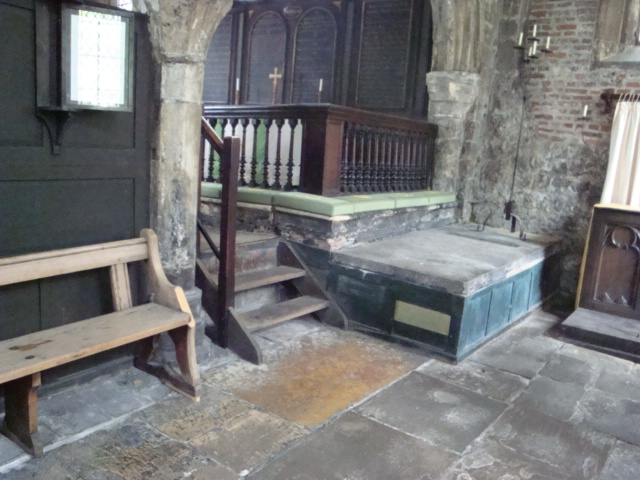
 The church was built in the 1100's, but was fitted with box pews in the 15th century. It is one of the few places in England that still has the original pews. Apparently they were put in for families to sit at while listening to the long sermons of Protestant ministers. Lunch would be brought, and depending on the exact congregation, activities for the children may also have been included.
 So many people were buried in this church that the main floor is now a couple of feet higher than the original floor. This shot was taken from a side apse.
 The church is also known for its medieval stained glass windows that somehow survived World War II fairly intact, though some small repairs had to be done. I got such a kick out of this repair, I had to take a close up of it for my husband. Plus it's cute.
The windows (obviously):
 The repair:
 I don't know why they decided little yellow cartoon airplanes, but there you are.
My computer is being weird - either that or my internet connection is - so I'm going to close this entry. Next week, I'll post some other random York pictures, and try to tell you a bit about my actual work. Most days I don't really go rambling over the local countryside, but sit and read and think about the PhD stuff. My husband reminded me today that was
original intention of the blog, so I probably ought to mention it from time to time.
Back to York...
There are a great many churches within Medieval York, which surprised me at first. I didn't think there were enough people that lived there at the time to support that many, but then Janilee reminded me that it was a county seat and a major international trade center. There may not have been that large (comparatively) of a permanent population, but the numbers coming in and out of the city made up the difference.
The Holy Trinity Church (Goodramgate) is kinda hard to find. The entrance is a small iron gate with a triangular clapboard sign that is put out during business hours. The yard and church are behind tall walls that don't look any different than all the other back sides of other buildings in the area. I think we passed it three times before I noticed the sign board. Oh, and you have to specify the Goodramgate part to differentiate it from the other Holy Trinity churches in town.
When you get through the gate you see this:


The windows (obviously):


My computer is being weird - either that or my internet connection is - so I'm going to close this entry. Next week, I'll post some other random York pictures, and try to tell you a bit about my actual work. Most days I don't really go rambling over the local countryside, but sit and read and think about the PhD stuff. My husband reminded me today that was
original intention of the blog, so I probably ought to mention it from time to time.
Subscribe to:
Posts (Atom)